
Overview
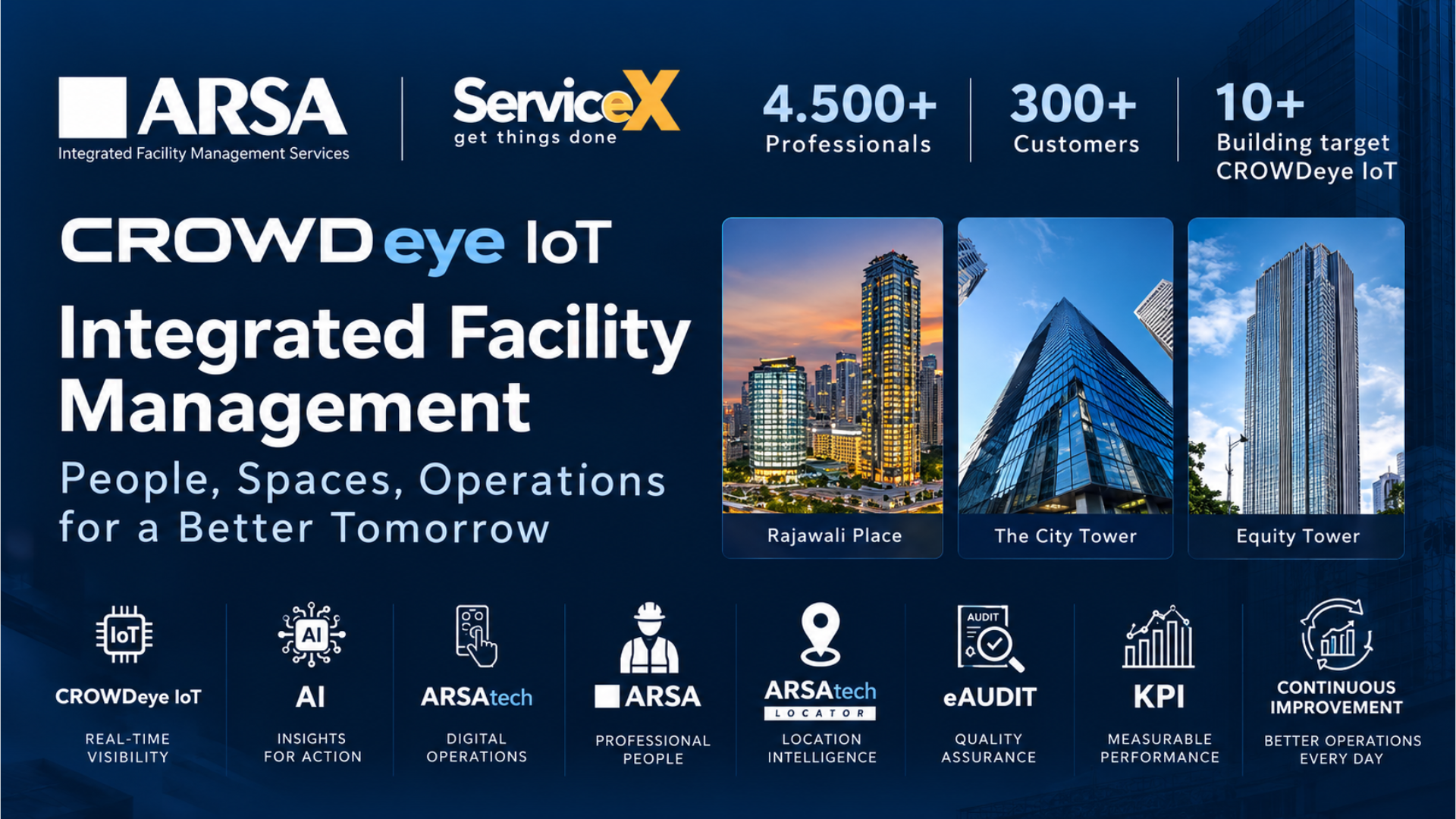
ARSA is an Integrated Facility Management Services (IFMS) company that brings together people, facilities, processes, technology, data, and operational control within one integrated management system.
Supported by more than 4,500 professionals, ARSA serves over 300 clients and operates across multiple locations and industry sectors throughout Indonesia.
ARSA’s services include Cleaning Services, Access Control, Mechanical, Electrical, Civil & Plumbing (MECP), Front of House, Integrated Pest Control Services, Landscape Management, Healthcare Services, Rope Access & Facade Services, Driver Services, and other supporting facility services.
ARSA serves a diverse range of facilities, including hospitals, office buildings, apartments and residential properties, shopping malls, industrial and manufacturing facilities, logistics facilities, commercial properties, restaurants and food courts, as well as sports and recreational facilities.
Integrated Facility Management
As an IFMS company, ARSA integrates Soft Services and Hard Services within a single management framework.
Each service function is connected through organizational structure, operating standards, personnel competency, supervision, technology, performance measurement, audits, corrective actions, and continuous improvement.
This approach enables facilities to be managed in a more coordinated, measurable, transparent, safe, responsive, and efficient manner, while providing greater visibility into actual conditions in the field.
ARSA focuses on ensuring that People, Spaces, and Operations work as one ecosystem that supports the facility user experience, productivity, workplace quality, and business continuity for its clients.
Credibility And Management Standards
ARSA’s credibility is built on operational experience, management systems, human resource competencies, compliance, technology, and the ability to manage operations on a large scale across facilities with diverse characteristics.
ARSA implements ISO 9001 Quality Management System, ISO 14001 Environmental Management System, ISO 45001 Occupational Health and Safety Management System, as well as SMK3 with an achievement of 90.62%.
ARSA is also affiliated with relevant professional and industry associations, including APKLINDO, ASPPHAMI, and ABUJAPI, in accordance with the areas of services it provides.
These standards are translated into operational practices through Manuals, SOPs, Work Instructions, forms and documentation, competency standards, personnel readiness audits, performance audits, corrective actions, preventive actions, and continuous improvement.
Through this approach, company standards do not stop at documentation but are translated into ways of working that can be implemented, inspected, measured, and continuously improved.
People And Leadership
ARSA’s greatest strength is its people. Thousands of KawanARSA personnel work every day across various client facilities, each with different operational characteristics, service requirements, and levels of complexity.
Human resource management is an integral part of the service delivery system, covering recruitment, onboarding, training, competency development, supervision, productivity measurement, performance evaluation, coaching, counselling, and leadership development.
The Eagle Fly Low philosophy encourages ARSA leaders to be present in the field, understand actual conditions, listen to clients and KawanARSA personnel, inspect work quality, and ensure that follow-up actions are carried through to completion.
This culture is reinforced through PAS — Patuh, Ahli, Sistematis and ServiceX — Selesai!
ARSAtech: Technology-Enabled Facility Management
ARSA developed ARSAtech as a digital ecosystem that connects field activities with data, monitoring, analysis, action, verification, measurement, and decision-making.
The ecosystem includes Attendance, eWORKplan, eClassroom, eFORMS, eSCM, eAUDIT, Action Plan, Client Solution, TakeMe, Structure, FitUP!, Locator BLE, NFC Service Point, Panic Button, Work Order, Command Center, as well as integration with IoT and operational communication systems.
The technology is designed to provide visibility, traceability, accountability, speed of response, productivity, quality control, and data that can be used for operational decision-making.
CROWDeye IoT: From Facility Conditions To Action
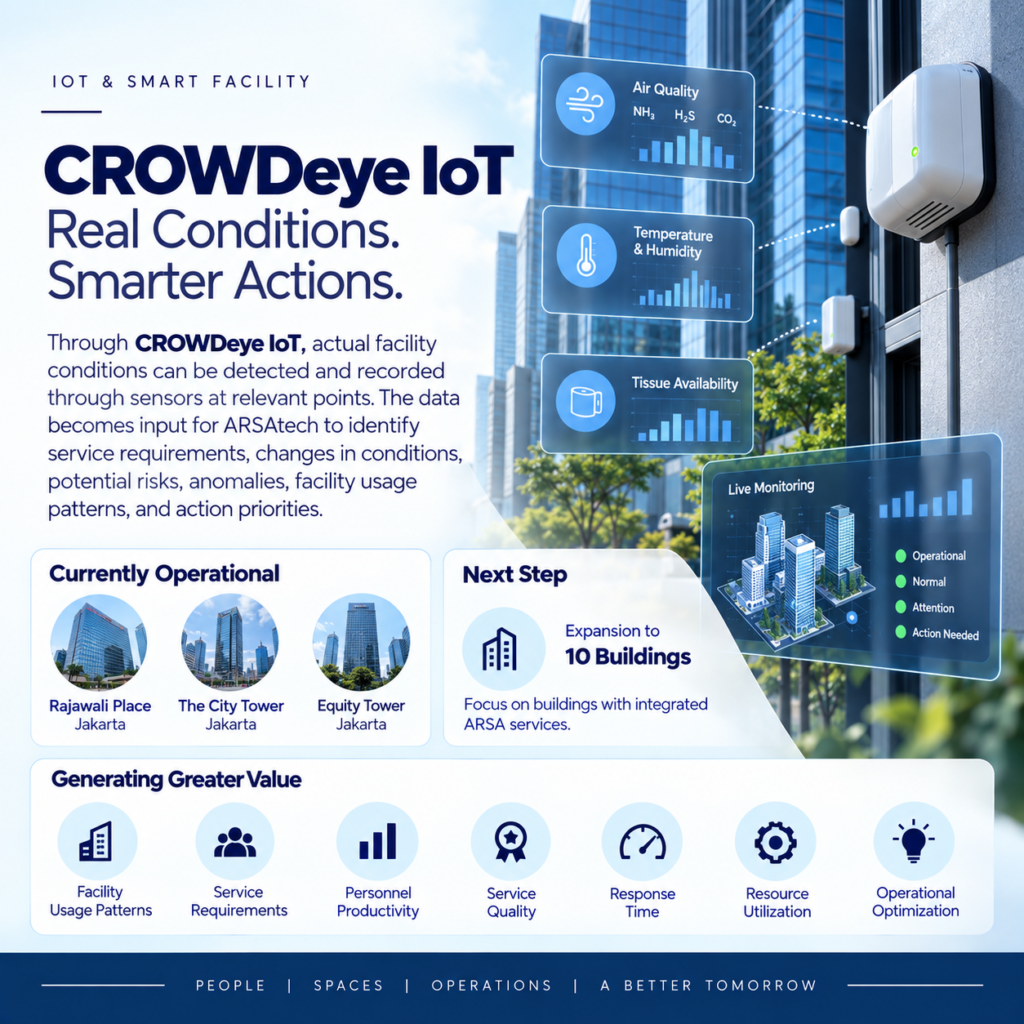
Through CROWDeye IoT, actual facility conditions can be detected and recorded through sensors installed at relevant points. The data serves as input for ARSAtech to identify service requirements, changes in conditions, potential risks, anomalies, facility usage patterns, and action priorities.
The implementation of CROWDeye IoT is fully operational at Rajawali Place, The City Tower, and Equity Tower in Jakarta.
At these locations, CROWDeye IoT forms part of ARSA’s operational ecosystem, connecting facility conditions with data analysis and operational actions. This implementation also provides practical experience and actual data to continuously refine ARSA’s condition- and demand-based facility management model.
ARSA is targeting the expansion of CROWDeye IoT to up to 10 buildings, particularly buildings where multiple ARSA services are delivered in an integrated manner.
The objective is to build an increasingly connected network of facilities, enabling data from multiple buildings to provide insights into facility usage patterns, service requirements, personnel productivity, service quality, response time, resource utilization, and opportunities for operational optimization.
MULTIPLE BUILDINGS ⟶ CONNECTED OPERATIONS ⟶ CONSOLIDATED DATA ⟶ OPERATIONAL INTELLIGENCE ⟶ BETTER DECISIONS ⟶ CONTINUOUS IMPROVEMENT
As more facilities become connected, ARSA can build a broader operational database to support benchmarking, trend analysis, predictive insight, resource optimization, and the development of increasingly data-driven service standards.
Closed-Loop Facility Management
ARSA builds technology as a closed-loop facility management system. Data does not stop at dashboards or reports. Every piece of information must be translated into action, every action must be verifiable, and every result must be measurable.
CROWDeye IoT — DETECT & CAPTURE
Detects and records the actual condition of facilities and changes occurring within service areas.
⟶ ANALYZE & PRIORITIZE
Data is analyzed to identify needs, anomalies, risks, usage patterns, and the priority level of required actions.
⟶ ARSAtech — ASSIGN & ESCALATE
Identified needs are translated into Work Orders, assigned to the responsible personnel or function, and escalated when attention is required at the next level.
⟶ KawanARSA — EXECUTE & RESOLVE
Personnel execute actions based on actual conditions, SOPs, service standards, SLAs, and defined priorities until the work is completed.
⟶ Locator — TRACK & VERIFY
Presence, location, movement, visits, and service activities can be tracked to provide evidence of work execution.
⟶ eAUDIT — INSPECT & VALIDATE
Work results are inspected to ensure quality, compliance, effectiveness of actions, and validity of completion.
⟶ KPI DASHBOARD — MEASURE & CONTROL
Data is consolidated to measure SLA, response time, completion time, productivity, quality, resource utilization, operational trends, and other performance indicators.
⟶ CONTINUOUS IMPROVEMENT — LEARN & OPTIMIZE
Measurement results are used for corrective action, preventive action, manpower optimization, work method enhancement, productivity improvement, cost control, and continuous service quality improvement.
The cycle continuously repeats:
DETECT & CAPTURE ⟶ ANALYZE & PRIORITIZE ⟶ ASSIGN & ESCALATE ⟶ EXECUTE & RESOLVE ⟶ TRACK & VERIFY ⟶ INSPECT & VALIDATE ⟶ MEASURE & CONTROL ⟶ LEARN & OPTIMIZE
The ARSA principle is simple:
Data Without Action Is Noise.
Data must generate action. Every action must have an accountable owner. Execution must be traceable. Completion must be verified. Results must be measured. Measurement results must drive the next improvement.
DATA ⟶ ACTION ⟶ VERIFICATION ⟶ MEASUREMENT ⟶ IMPROVEMENT
Data-Driven Operations
ARSA uses data to evolve facility management from a predominantly schedule-based approach toward an increasingly condition-based, demand-based, productivity-based, and performance-based approach, aligned with the characteristics of each facility and the readiness of implementation at each location.
Data is used to evaluate areas including traffic and utilization, personnel activity, visit frequency, response time, completion time, facility conditions, Work Orders, complaints, SLA, productivity, manpower requirements, work quality, and follow-up effectiveness.
With this approach, operational questions go beyond:
“Has the work been done?”
They evolve into:
“Was the work performed at the right time, in the right place, by the right resources, based on actual needs, and did it deliver the expected quality?”
This approach enables operational decisions to be increasingly based on evidence and actual conditions, allowing resources to be directed to the right location, time, and needs.
From Activity to Measureable Outcome
ARSA recognizes that the volume of activities does not necessarily reflect service success. Therefore, activities must be connected to measurable outcomes.
Performance is measured through indicators such as response time, completion time, SLA achievement, complaint reduction, manpower utilization, productivity, service frequency, quality improvement, cost efficiency, and service consistency.
Before-and-after data is used to evaluate whether changes in work methods, technology, IoT, manpower structures, and operational processes genuinely deliver improvements.
This approach also provides a more objective basis for evaluating manpower requirements and identifying efficiency opportunities without compromising quality or the service levels agreed upon with customers.
Operational Transparency and Traceability
ARSA promotes transparency through the digital recording of activities and work outcomes.
Facility conditions, alarms, Work Orders, complaints, personnel activities, response time, actions, verification, audits, and completion form an interconnected data trail that provides management with operational visibility.
The control principle:
EVERY CONDITION IS VISIBLE ⟶ EVERY ACTION IS ASSIGNED ⟶ EVERY EXECUTION IS TRACEABLE ⟶ EVERY RESULT IS VERIFIED ⟶ EVERY PERFORMANCE IS MEASURED ⟶ EVERY INSIGHT DRIVES IMPROVEMENT
Every finding has an action. Every action has an accountable owner. Every task is traceable. Every completion can be verified. Every result can be measured.
Operational Excellence and Continuous Improvement
ARSA builds a layered control system spanning from frontline personnel, Team Leaders, Supervisors, Assistant Managers, and Managers to senior leadership.
Each level is responsible for ensuring that work is performed, inspections are conducted, quality is maintained, findings are followed up, and actions deliver a tangible impact on service performance.
Findings are translated into an Action Plan, with accountable owners and completion targets defined, implementation verified, and effectiveness evaluated.
Through this approach, SOPs, supervision, inspections, audits, technology, IoT, data, Work Orders, Action Plans, and KPIs become integrated components of a single control and continuous improvement system.
Technology With Human Accountability
Technology strengthens the ability of people and organizations to execute operations effectively.
Sensors detect conditions.
Data provides information.
AI supports analysis.
ARSAtech directs action.
KawanARSA executes the work.
Locator provides traceability.
eAUDIT performs verification.
KPI Dashboard measures results.
Management ensures improvement takes place.
Ultimately, service quality is determined by an organization’s ability to see, understand, act, verify, measure, and resolve.
Therefore, ARSA’s digital transformation progresses alongside capability development, changes in ways of working, leadership presence, operational discipline, and a culture of resolution.
Building a Scalable IFMS Platform
With a combination of 4,500+ professionals, 300+ customers and service locations, standardized processes, management systems, ARSAtech, CROWDeye IoT, Locator, NFC, digital audits, productivity measurement, and continuous improvement, ARSA continues to build an Integrated Facility Management model that can be applied and developed across different types of facilities.
The full implementation of CROWDeye IoT at Rajawali Place, The City Tower, and Equity Tower, along with plans to expand toward 10 buildings with integrated services, forms part of ARSA’s journey toward building a broader connected facility ecosystem.
As more facilities become connected, ARSA’s ability to generate operational intelligence, benchmark performance patterns, identify improvement opportunities, optimize resources, and develop service methods based on actual data continues to grow.
Success in facility management is ultimately measured through tangible operational outcomes: service quality, SLA achievement, complaints, response time, completion time, productivity, manpower utilization, cost efficiency, compliance, and performance improvement before and after implementation.
This is ARSA’s direction as an Integrated Facility Management Services company: connecting People, Spaces, Operations, Process, Technology, Data, Governance, and Execution into a single service system that is measurable, traceable, responsive, accountable, scalable, and continuously improving.
People, Spaces, Operations, a Better Tomorrow.